A useful fee comparison is not about finding the lowest headline percentage. It is about identifying the documented costs for the same account, portfolio value and investment approach, then deciding whether the service attached to those costs fits what you need. This guide is general information, not personal financial, tax or legal advice.
What Counts as the Total Cost of Investing?
Start by treating the advertised platform or management fee as one line in a wider cost checklist. Depending on the provider, account and investments chosen, documented costs can include a platform or discretionary-management fee, underlying fund or ETF charges, dealing or trading costs, market spread, foreign-exchange charges, and charges connected with transfers or other account actions.
The exact mix matters. For example, InvestEngine says its DIY and Managed portfolios have ETF costs and market spread alongside its own stated fee structure. Wealthify describes fund and trading fees in addition to its own fee, and says those costs can vary by plan type. J.P. Morgan Personal Investing’s fee schedule also describes an annual fee for discretionary management and includes terms for investment transfers.
Use the current official pricing page, schedule of fees and account terms for every provider in your shortlist. Do not build a comparison from a single marketing rate, an old review, or a projected return. Record the account type and portfolio option next to each figure, because a price that applies to one service or account may not apply to another.
Fees are important, but they are only one part of an investing decision. Your investment risk, the investments available, the account’s tax treatment and the service you want all need separate consideration.
Separate Management Fees from Platform Fees
First identify what the recurring provider fee is paying for. A discretionary managed service can charge for selecting, monitoring or adjusting a portfolio on your behalf. J.P. Morgan Personal Investing states that it charges an annual management fee for discretionary management, calculated and accrued daily and deducted monthly; its schedule distinguishes Managed Investment Styles from its Fixed Allocation Investment Style.
A self-directed platform may charge for account access, or may state that it has no account fee, while leaving investment-level costs in place. InvestEngine states that its DIY option has a zero InvestEngine fee, but that ETF costs and market spread apply. Its Managed option states a 0.25% annual InvestEngine fee, with ETF costs and market spread also applying.
That distinction helps avoid comparing unlike services. A management fee is not automatically equivalent to a platform-access fee: one may include portfolio management, while the other may leave investment selection to you. Likewise, a stated zero platform fee does not establish a zero total investing cost.
Check whether the published rate depends on the investment style, value held, account type, or a tier. J.P. Morgan Personal Investing’s published schedule uses different pricing structures for its Managed and Fixed Allocation styles. Keep those conditions beside the percentage rather than flattening them into a single “best” rate.
Add Fund Charges, Trading Costs and Market Spread
AI-generated generic editorial illustration — not a retailer product photo and does not depict the reviewed product or service. Help readers see why headline platform fees alone are not a like-for-like total-cost comparison.
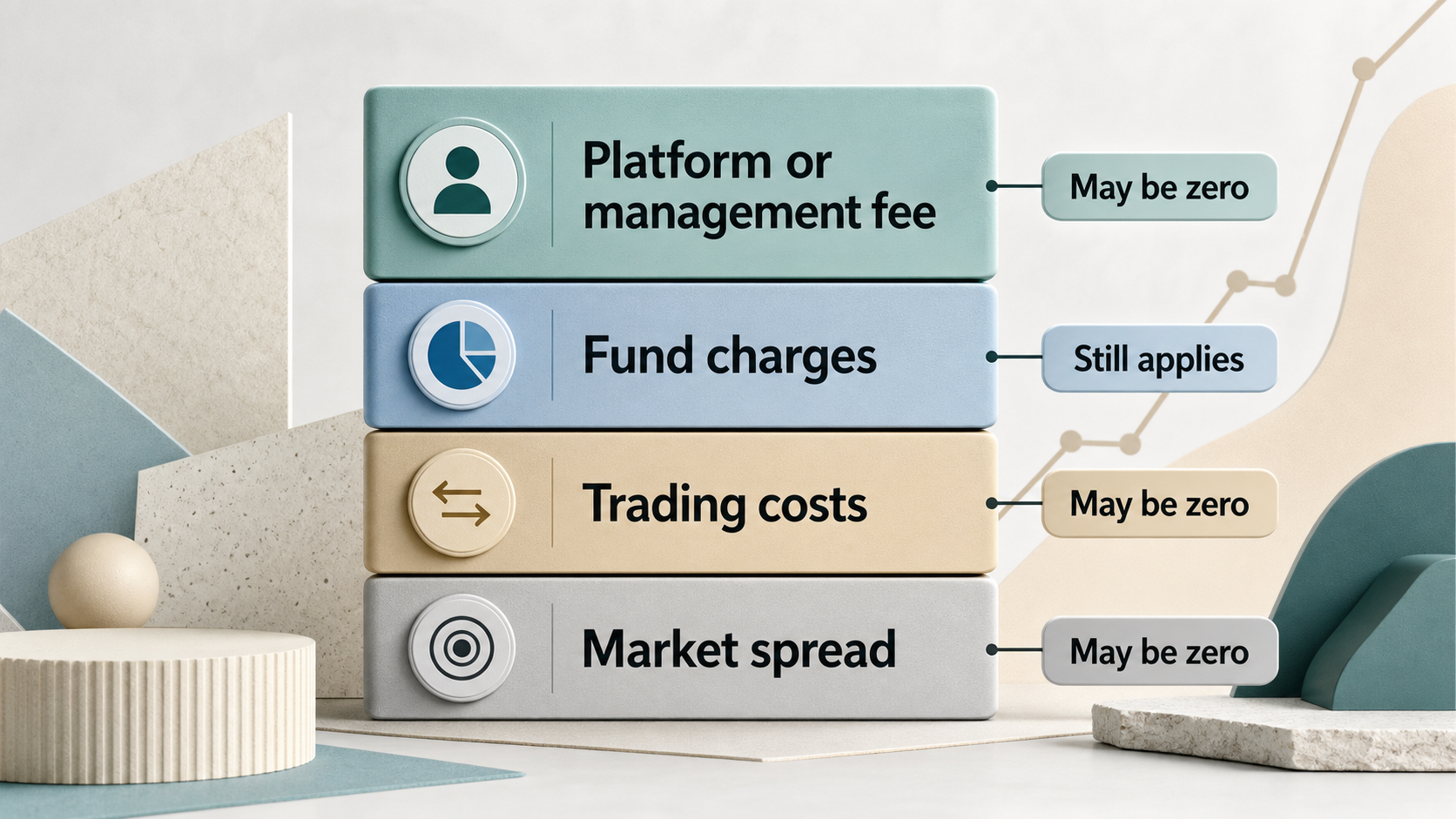 After finding the provider’s own fee, look at the charges that sit within or alongside the investments. Fund and ETF charges are generally associated with the investment products held; they are not necessarily replaced by a platform’s decision to charge no account fee. InvestEngine expressly says ETF costs apply to its portfolios, including those with a zero InvestEngine fee.
Trading-related costs may also need a separate line. Wealthify says its Investment Plans have approximate fund and trading fees of 0.14% a year for Original Plans and 0.46% a year for Ethical Plans, while also cautioning that fund and trading fees vary. This is a useful reminder to compare the portfolio you would actually choose, not just the provider name.
Market spread is another item to keep distinct. InvestEngine says market spread applies to both its DIY and Managed portfolios. A spread is an investment transaction cost; it is not the same thing as a platform commission. If a provider documents both, record them as separate cost categories rather than assuming one includes the other.
Where a provider gives an approximate or variable investment-cost figure, label it that way in your worksheet. Do not turn an estimate into a guaranteed annual charge, and do not assume a cost stated for one portfolio range applies to every account or investment option.
Build a Like-for-Like Cost Comparison
AI-generated generic editorial illustration — not a retailer product photo and does not depict the reviewed product or service. Give readers a repeatable, neutral workflow for comparing published charges across providers.
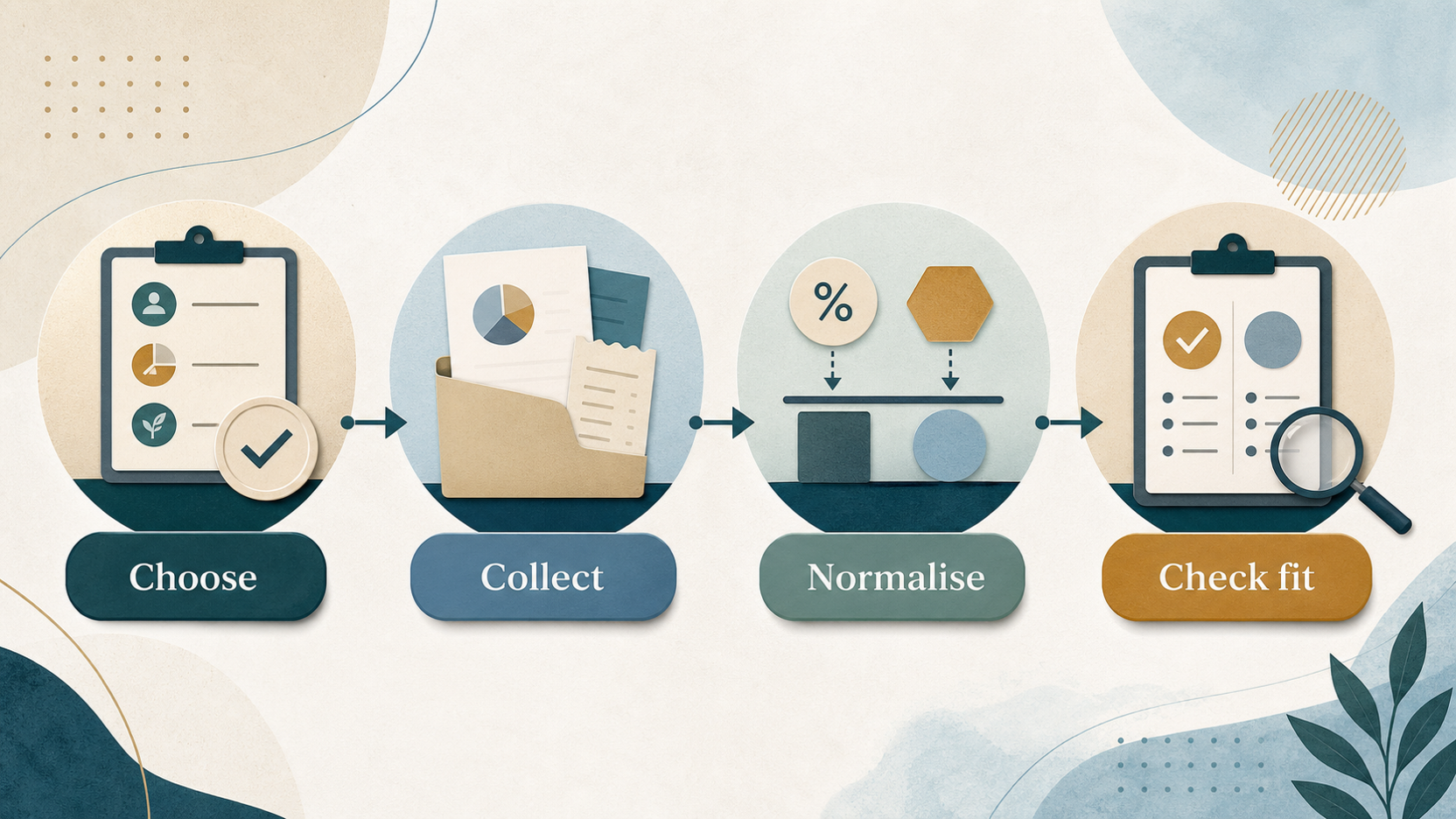 Use one worksheet and hold the assumptions constant for each provider:
- Choose the same portfolio value and the same account type.
- Choose a comparable investment approach: DIY investing, a managed portfolio, or another clearly defined service.
- Note how often you expect to deal, and whether you expect to use foreign currency or transfer investments.
- Copy the published provider fee, underlying investment costs, dealing charges, spread information and any relevant fixed charges.
- Preserve every threshold, exception, promotion and charging-frequency note.
Account type is not a label to skip. InvestEngine publishes separate account pages for an ISA, General Account, Personal Pension (SIPP) and Business Account, while J.P. Morgan Personal Investing’s schedule describes fees by Investment Style. Check the fee page and terms that correspond to the precise account and service you are considering. Do not use an ISA figure to represent a pension or general investment account without confirming that the same terms apply.
Then log the less prominent terms, even if the provider describes some as zero. Wealthify says it does not charge for deposits, withdrawals, transfers or closing a Plan. That is useful information, but it belongs in a documented comparison alongside the account and portfolio to which it applies. J.P. Morgan Personal Investing’s schedule refers to transfers of investments as “In Specie Transfer”, so transfer arrangements should also be read in the provider’s current detailed terms.
A simple worksheet might have columns for account type, service type, balance assumption, annual provider fee, underlying fund/ETF cost, trading or dealing cost, market spread, FX, transfer/withdrawal/closure terms, and notes. Its purpose is clarity, not a provider ranking.
Calculate the Documented Annual Cost
Convert percentage-based charges into illustrative cash amounts using your chosen balance. The basic calculation is:
illustrative annual cost = assumed portfolio value × annual percentage charge
Apply it separately to each published percentage, then show the components rather than hiding them in one unexplained total. For example, if an investment cost is stated separately from a provider fee, calculate each against the same assumed balance only where the provider’s wording makes that comparison appropriate. Add fixed charges only if they apply to your expected account use or dealing pattern.
Keep tiers intact. A rate that changes with the value held, investment style or eligibility should be calculated within the relevant band or clearly marked as an illustration. J.P. Morgan Personal Investing’s schedule says its management fee is calculated as a percentage of the investments held in each relevant Investment Style, and distinguishes the pricing structure for Fixed Allocation from Managed styles.
Also record when money is collected. Wealthify says its fees are quoted annually but charged monthly, and that the amount paid varies with the value of investments across the month. J.P. Morgan Personal Investing says its annual management fee is calculated and accrued daily and deducted monthly. An annualised percentage therefore helps comparison, but it does not by itself describe every detail of how a charge is collected.
This calculation is a fee illustration, not a return forecast. It does not predict investment performance, personal tax outcomes, or which provider is best for you.
Use Fees Alongside Service and Account Fit
A lower documented fee may not settle the decision. Before acting, check whether the provider offers the account you need, the investment approach you want, and the level of management or support you expect. A DIY service and a discretionary managed portfolio can both be valid options, but they provide different things.
Review the current fee schedule again before opening, transferring or changing an account. Check for temporary reduced rates, tier thresholds, the current cost of the investments you intend to hold, and the applicable transfer conditions. J.P. Morgan Personal Investing says it may apply a reduced fee in certain circumstances where its eligibility criteria are met, including promotional campaigns; that is a reason to record the conditions, not to assume a reduction will apply.
Consider your investment objectives, risk tolerance and tax position separately from the fee worksheet. With investing, your capital is at risk. The information here is general and cannot determine suitability, personal tax treatment or legal consequences for an individual reader.
Frequently Asked Questions
Does a zero platform fee mean investing is free?
No. InvestEngine states that ETF costs and market spread apply to its portfolios even where the InvestEngine fee is zero. Check the underlying investments and transaction-related terms as well as the provider’s account fee.
Should I compare fees using an ISA, a pension or a general investment account?
Compare the account you actually expect to use. Providers can publish separate account options and terms, so use the matching ISA, pension/SIPP or general-account documentation rather than assuming one account’s price applies to another.
How often should I check a platform’s fee schedule?
Check it when you make a decision to open, transfer, add money to, or change an account, and revisit it periodically. Current schedules can contain eligibility conditions, tiered prices or promotional reductions that affect a previous comparison.
Can moving investments to another platform create costs?
It can create terms that need checking. Wealthify states that it does not charge for transfers of its Plans, while J.P. Morgan Personal Investing’s schedule includes terms for transfers of investments. Review both sides of a proposed move and the current account terms before proceeding.
Before you decide, complete the same-account, same-balance worksheet and verify every figure against the provider’s current official documentation.
Sources
Related reading
- Best digital investment platforms in the UK: an evidence-led comparison of fees, accounts and service models
- Wealthify review: plans, fees, account choices and practical limits
- How to choose a managed investment platform: fees, risk, account wrappers and support
- Investment platform deals and fee waivers: how to check total cost, eligibility and expiry terms
Editorial information: About our editorial team · Read our editorial policy · Read our affiliate disclosure.