Wealthify at a Glance
Wealthify is a UK digital investing service built for people who would rather choose a managed portfolio than select individual shares, bonds or funds themselves. Its investment Plans use passive funds containing a spread of underlying assets, and the mix changes according to the risk level selected. That makes the central question less about finding a single “best” platform and more about whether a managed, risk-rated approach matches the degree of control you want.
The service also presents information on investment accounts alongside cash-focused options, so it is important to identify the product category before comparing features, risk and protection. An investment Plan can fall in value; a cash product and an investment portfolio should not be treated as interchangeable.
This review is general information for UK adults. It is not personal investment, tax or legal advice. Tax treatment depends on individual circumstances and can change, while the right account depends on your objectives, time horizon and capacity to accept losses.
How Wealthify Investment Plans Work
Wealthify says its experts build Plans from a range of passive investment funds. A fund is a collection of assets—such as shares, bonds or property exposure—held together, rather than a single investment chosen by the customer. The mix is linked to attitude to risk: lower-risk Plans contain a higher proportion of lower-risk investments such as bonds, while higher-risk Plans include more shares.
There are five Original Plan labels: Cautious, Tentative, Confident, Ambitious and Adventurous. Wealthify also lists Ethical Plans using the same five risk labels. These labels describe a risk spectrum, not a guarantee of a result or a recommendation for any particular reader.
AI-generated generic editorial illustration — not a retailer product photo and does not depict the reviewed product or service. Help readers understand that the managed-plan choice is primarily a risk-level decision rather than individual fund selection.
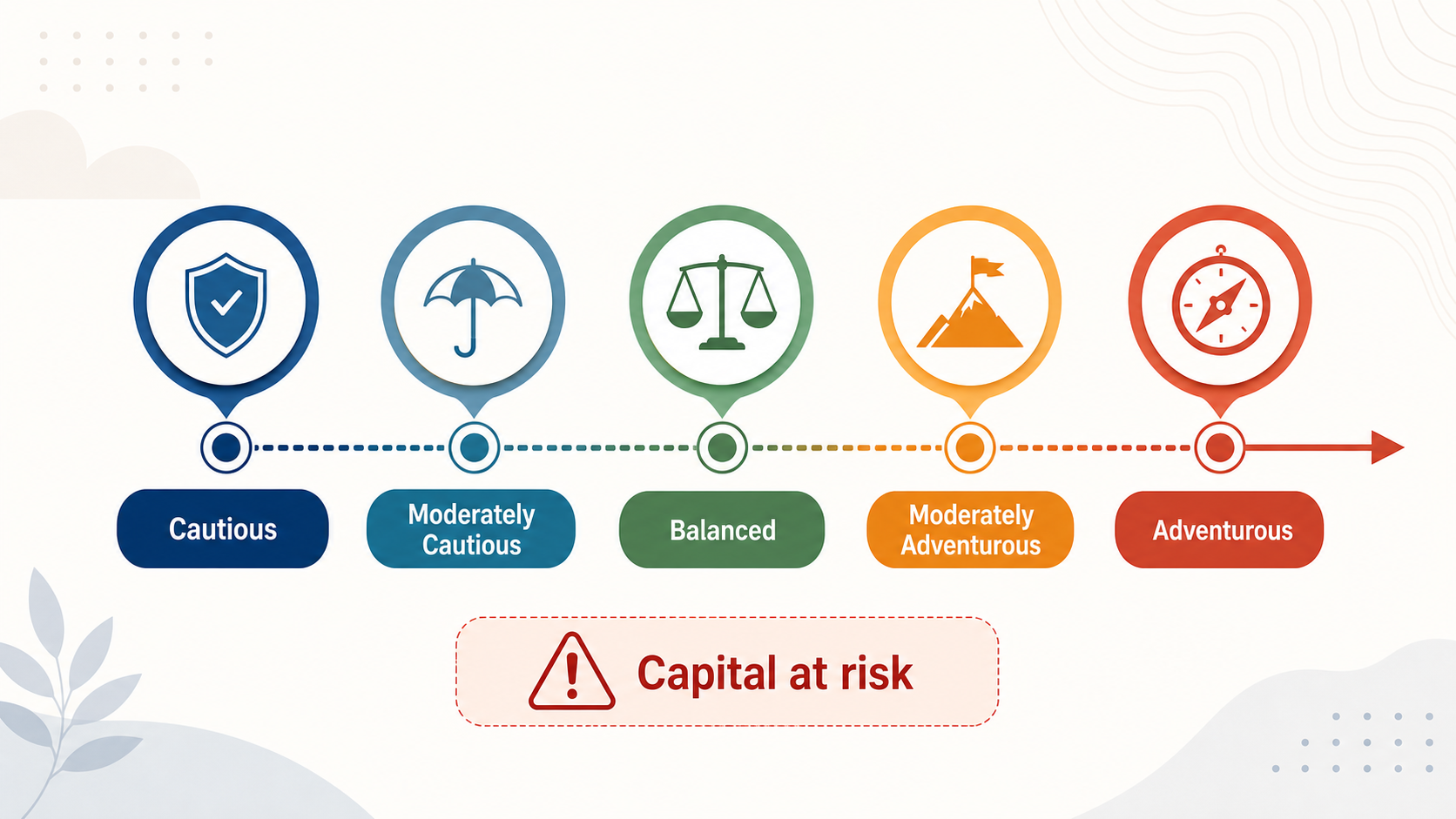
The provider says it makes adjustments to the investment mix as markets change. That ongoing management can be useful for someone seeking a delegated approach, but it also means you are choosing a provider-designed portfolio rather than directing every underlying holding yourself. Before investing, read the relevant Plan factsheet and make sure you understand what the chosen risk level means in practice.
Account Choices and What They Are For
Wealthify’s official site groups information around Stocks and Shares ISAs, Junior ISAs, pensions, Cash ISAs, savings accounts and Ethical Accounts, alongside its investment Plans. Those labels are a starting point for narrowing the comparison; they do not mean every option has the same purpose, tax treatment or risk profile.
For example, an investment account is intended to hold a portfolio whose value can move with markets. A Cash ISA or savings product is a cash-focused option and should be assessed under its own terms, including access and protection arrangements. The legal and regulatory FAQ separately refers to General Investment Accounts, Stocks and Shares ISAs, Junior ISAs and Self-Invested Personal Pensions when explaining where money and assets are held.
Start with the job the account needs to do: investing for a long-term goal, saving cash, providing for a child, or considering pension saving. Then check the current eligibility rules, contribution limits, transfer process and product terms directly with Wealthify. Do not assume that an account label alone answers those questions.
Fees and Costs to Compare
Wealthify states that fund and trading fees are approximately 0.14% a year for Original Plans and 0.46% a year for Ethical Plans. It also says these costs can vary. Those figures are only part of a useful comparison: readers should identify the full set of charges that applies to the particular Plan, account and balance they are considering.
The provider says fees are quoted annually but charged monthly, and that the amount paid varies with the total value of Plans during the month. This is why it is worth converting percentages into pounds at a realistic balance and checking whether the fee calculator or current terms identify additional elements relevant to your circumstances.
Wealthify says it does not charge for deposits, withdrawals, transfers or closing a Plan. That is helpful context, but it is not a complete comparison of the cost of investing. Fund and trading costs, portfolio choice, tax wrapper, access needs and charges elsewhere all still matter. Check the current fee page and Plan documents before opening or transferring an account.
Potential Strengths
The clearest potential strength is simplicity. Wealthify’s model gives customers access to diversified passive-fund portfolios without requiring them to research and select individual assets. The five-step risk range gives a straightforward framework for considering how much market exposure may be appropriate to investigate.
The provider also describes ongoing monitoring and adjustments to keep a Plan aligned with its chosen investment style. For readers who value delegated portfolio management, that may be more practical than maintaining a self-directed portfolio. It is a feature of the service, not evidence that a Plan will outperform another investment approach.
Wealthify says customers can track money online or in the app and can contact support through live chat, telephone and email. These are documented access and support channels; they are not a finding about response times or service quality. The useful comparison is whether the available support, account access and portfolio-management model suit how you expect to use the account.
Practical Limits and Risks
The principal investment risk is explicit: capital is at risk. The value of a Plan can fall, and you may receive back less than you put in. A higher-risk Plan includes more shares according to Wealthify’s description, but no risk label removes the possibility of loss.
There is also a control trade-off. Wealthify constructs and adjusts the portfolios, so this model may not suit someone who wants to choose individual securities or control each fund allocation directly. Ethical Plans may be relevant to readers who want that option, but they still need to inspect the current factsheet, investment approach and charges rather than infer holdings from the label alone.
FSCS protection is not protection against disappointing investment performance. Wealthify says the FSCS does not cover a situation where investments perform below expectations and an investor gets back less than originally invested. Its legal FAQ also distinguishes investment arrangements from cash held with its banking provider for new ISA and GIA customers. Check the current official terms for the protection that applies to the specific firm, account and cash balance involved.
Who Wealthify May Suit
Wealthify may be worth comparing if you want a UK digital platform with managed portfolios, prefer selecting a broad risk level over building a portfolio from scratch, and are comfortable with investment risk. It may also be relevant if the account types or Ethical Plan range align with the purpose you are researching.
It may be less suitable for someone who wants direct control over individual investments, cannot accept fluctuations in portfolio value, or is looking for a cash product but has not yet compared its access and protection terms with other cash options. The right conclusion is not a universal yes or no; it follows from the account purpose, desired control, risk tolerance, ethical preference and total costs.
Compare Wealthify’s current Plan factsheets, fees and account terms with alternatives that offer the same type of account and service. For ISAs and pensions, also consider your personal tax position before acting.
How to Compare Wealthify Before You Apply
Use a short checklist before opening, funding or transferring an account:
- Confirm the account’s purpose and whether it is an investment or cash product.
- Read the factsheet for the selected Original or Ethical Plan and consider whether you understand the risk level.
- Calculate the current percentage charges in pounds at your likely balance, including the applicable fund and trading costs.
- Check deposits, withdrawals, transfers, minimums, eligibility and closure terms in the latest official documentation.
- Read the current explanation of how money, assets and eligible cash are held, including the limits of FSCS protection.
- Compare like-for-like alternatives before making a decision.
A referral guide can help structure the comparison, but current official documents should take priority over older fee examples or product descriptions.
Frequently Asked Questions
What is included in a Wealthify investment plan?
Wealthify says a Plan is built from a range of passive investment funds. Those funds can provide exposure to many underlying assets, such as shares, bonds or property, and the mix depends on the chosen risk level. The provider says it adjusts the mix from time to time as markets change.
How much do Wealthify investment plans cost?
Wealthify states that fund and trading fees are approximately 0.14% a year for Original Plans and 0.46% a year for Ethical Plans, with variation possible. Fees are quoted annually and charged monthly, so check the current fee information and calculate the likely pound amount for your balance.
Is Wealthify regulated in the UK?
Wealthify says it is authorised and regulated by the Financial Conduct Authority. Readers should still verify the current legal and regulatory information before acting, particularly if their decision depends on a specific account, provider relationship or protection arrangement.
Does FSCS protection cover investment losses on a Wealthify plan?
No. Wealthify says the FSCS does not cover an investment performing below expectations where you receive less than you originally invested. For any cash held in connection with an account, check the latest official terms to understand the relevant provider and scope of protection.
Sources
Related reading
- Best digital investment platforms in the UK: an evidence-led comparison of fees, accounts and service models
- Moneyfarm review: who the platform may suit and where its limits matter
- InvestEngine review: DIY, managed portfolios, fees and trade-offs
- Managed vs DIY investment platforms: how control, cost and responsibility differ
Editorial information: About our editorial team · Read our editorial policy · Read our affiliate disclosure.