J.P. Morgan Personal Investing is worth considering if you want a portfolio to be managed for you and are comfortable giving up the day-to-day decisions of a DIY account. Its published information points to a long-term, discretionary investing service with several investment styles, visible charges and flexible withdrawals. It is less naturally suited to someone who wants to trade individual holdings themselves or is investing for a short timeframe.
This review is general information for UK residents, not personal financial, tax or legal advice. Capital is at risk, and the value of investments can fall as well as rise.
J.P. Morgan Personal Investing at a Glance
The central question is whether delegated portfolio management is more valuable to you than direct control. J.P. Morgan Personal Investing says it manages money through different investment styles and charges a management fee that varies with both portfolio value and style. You can view charges in the app, while fund charges and market-spread costs remain separate parts of the overall investing cost.
That makes it a managed-investing proposition rather than a simple share-dealing account. The investor chooses an appropriate product and investment style, supplies and withdraws money subject to the relevant account rules, and monitors the outcome. The provider undertakes the ongoing portfolio-management work.
For a UK resident with a multi-year horizon who wants a digital route into an investment portfolio, that division of labour can be a sensible fit. It is not an automatic recommendation: compare the total cost, investment approach, account eligibility and withdrawal rules against your own priorities. If control over every trade is essential, a DIY platform may be the more direct comparison.
What Is J.P. Morgan Personal Investing?
 J.P. Morgan Personal Investing describes an investment service in which it charges for the discretionary management of a portfolio. Its published fee information identifies Fully Managed, Socially Responsible Investing, Thematic investing, Income investing and Smart Alpha as Managed Investment Styles. It also offers a Fixed Allocation Investment Style, which has a separate pricing structure.
The practical distinction is important. A managed style is intended to put portfolio construction and ongoing management with the service, rather than asking the customer to select and rebalance every holding. The provider says its clients benefit from bulk trading and that doing the monitoring and rebalancing independently can involve time, hassle and trading charges. That does not mean a managed portfolio removes risk; it changes who carries out the implementation work.
The FAQ states that the offering is designed for long-term investors and suggests considering a minimum timeframe of three years. It also says clients can withdraw whenever they like, with no minimum investment period, although Junior ISAs, Lifetime ISAs and Personal Pensions have particular withdrawal restrictions. This is therefore most coherent as a longer-horizon service, not a short-term trading tool.
Before opening an account, check the current product terms and decide whether the available investment style, account type and risk level match your circumstances. General service information cannot establish what is suitable for an individual investor.
Fees and Charges
AI-generated generic editorial illustration — not a retailer product photo and does not depict the reviewed product or service. Help readers understand the documented components of total investing costs without implying a comparison ranking.
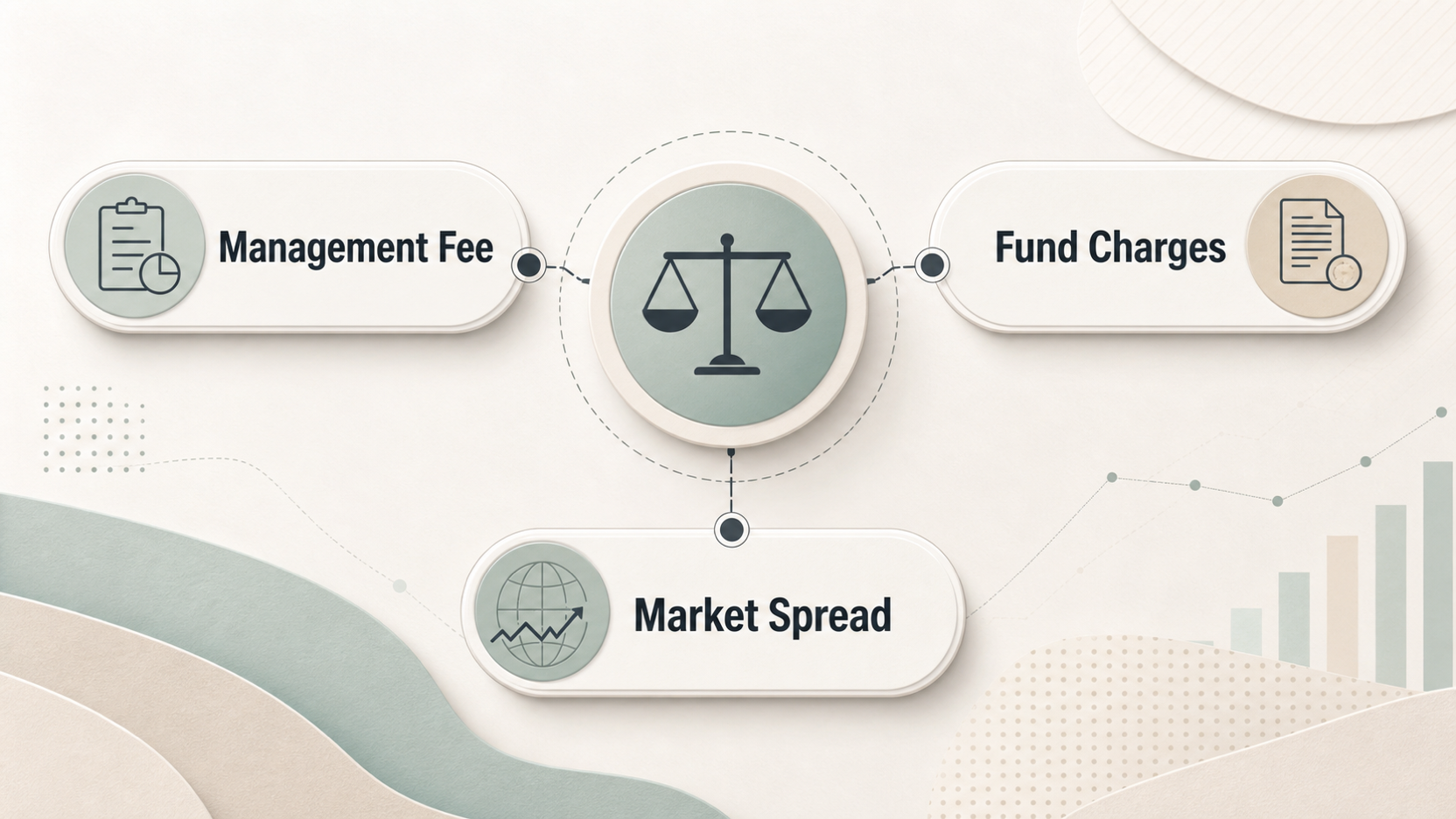 Cost comparison should start with the distinction between the management fee and the costs embedded in investments. J.P. Morgan Personal Investing says customers see three separate charge types: its management fee, investment fund charges and market spread. The management fee depends on the amount invested and the chosen investment style; fund charges and dealing-related costs are reflected in investment performance, while market spread is another component to consider.
Its Schedule of Fees and Charges, effective from 17 June 2025, says the annual management fee is calculated and accrued daily and deducted from the portfolio monthly. The schedule lists annual managed-style rates of 0.75% and 0.35% including VAT, and Fixed Allocation rates of 0.45% and 0.25% including VAT. The relevant value bands and current terms should be checked in the full schedule before relying on a rate for a particular portfolio size.
The service says management fees are taken automatically on the first working day of the month. It also says a breakdown of fees and charges is available in the dashboard. This visibility can help, but it is still worth comparing like with like: management fee, underlying fund costs, transaction-related effects, any account-specific charges and the investment approach should all be assessed together.
Avoid treating a headline percentage as a verdict on value. A lower or higher management fee may be attached to a different service model, portfolio method or level of support. The useful question is whether the documented service and total costs are appropriate for the portfolio you intend to hold over time.
Key Strengths
One documented strength is the hands-off structure. The service manages portfolios on a discretionary basis, while clients can select from managed and fixed-allocation styles. For an investor who does not want to monitor holdings or arrange rebalancing personally, that can make the process easier to maintain.
The published FAQ also says there is no minimum investment period and that clients can withdraw whenever they like. The fee page says it is free to join and that it does not charge for withdrawals. These features may appeal to someone who wants to start investing without committing to a fixed lock-in period, while recognising that the tax wrapper or product can still affect withdrawal options.
Fee visibility is another practical benefit. J.P. Morgan Personal Investing says customers can check what they are paying in the app and find a charges breakdown in the dashboard. Its explanation of bulk trading and portfolio monitoring also gives prospective clients a clear picture of the work being delegated.
These are service features, not guarantees of returns. A managed approach can save time, but it does not remove market movements, fund costs or the need to choose an investment horizon that can absorb volatility.
Limitations and Risks to Consider
The first limitation is investment risk. J.P. Morgan Personal Investing explicitly states that capital is at risk. A managed portfolio can still lose value, and historical performance should not be treated as a prediction of future outcomes. Anyone who may need the money soon should consider whether investing is appropriate before focusing on platform features.
The service's own suggested minimum timeframe is three years, and it describes the offering as intended for long-term investors. That makes a short-term goal a weaker fit. Even though clients can generally withdraw whenever they like and there is no minimum investment period, selling after a market fall can crystallise a loss.
Withdrawal flexibility also varies by wrapper. The FAQ highlights restrictions for Junior ISAs, Lifetime ISAs and Personal Pensions, and says that withdrawing from an ISA does not restore the withdrawn part of the annual allowance. Check the current rules for the specific account rather than assuming a general withdrawal statement applies unchanged.
Finally, delegated management is a trade-off. Investors who want to choose individual securities, place their own trades or make frequent tactical changes may prefer a DIY platform. The service can manage a portfolio, but it cannot turn a preference for full control into a managed-service advantage.
Alternatives to Consider
A useful comparison is between three broad routes: a DIY investment platform, another managed portfolio service and an advice-led service. DIY platforms may suit people who want to select their own funds or shares and take responsibility for monitoring and rebalancing. Other managed services may suit people who want delegation but prefer a different portfolio method, fee model or digital experience. Advice-led options may be relevant where a person needs individual financial planning rather than general platform information.
Independent UK editorial coverage continues to compare investment platforms for beginners, which reinforces the value of looking beyond one provider. However, a broad platform guide is not a substitute for checking the current terms of the specific service you are considering, and it should not be used to infer a ranking that its evidence does not establish.
For each alternative, compare total charges rather than only a headline fee. Also check account eligibility, available investment styles, portfolio construction, support, withdrawal treatment and the level of control you retain. A regular-investing guide and a managed-versus-DIY comparison can help structure that exercise.
The right alternative depends on the job you need the account to do. If the priority is delegation, compare managed services on their documented method and cost. If the priority is autonomy, compare DIY tools and the effort required to use them responsibly. If your decision depends on personal tax, pension or wider financial-planning questions, seek appropriately qualified advice.
Who J.P. Morgan Personal Investing May Suit
This service may suit a UK resident who wants a long-term digital investment portfolio managed on their behalf, values access to several investment styles and prefers not to undertake routine monitoring and rebalancing. The lack of a stated minimum investment period and the ability to withdraw in general may also matter to someone who wants flexibility, provided they understand the rules of the chosen account.
It may be a weaker fit for someone with a short investment horizon, a need for certainty about capital value or a strong preference to choose and trade holdings personally. It also needs more careful comparison if you expect to use a Junior ISA, Lifetime ISA or Personal Pension, because withdrawal restrictions can apply.
A practical next step is to list your horizon, desired level of control, intended account type and likely portfolio value, then compare the current fee schedule and product terms against at least one DIY and one managed alternative. This review is informational only and cannot determine individual suitability.
Compare current platform deals →
Frequently Asked Questions
Is there a minimum investment or minimum investment period?
J.P. Morgan Personal Investing says there is no minimum investment period. Its FAQ also says the service is designed for long-term investors and suggests considering a minimum timeframe of three years. Check the latest account terms for any product-specific conditions.
How and when are management fees charged?
The published schedule says the annual management fee is calculated and accrued daily, then deducted from the portfolio monthly. The fee page says management fees are taken automatically on the first working day of the month. The applicable percentage depends on investment style and portfolio value, so check the full current schedule.
Can I withdraw money from J.P. Morgan Personal Investing?
The FAQ says clients can withdraw whenever they like and that there is no minimum investment period. It also flags withdrawal restrictions for Junior ISAs, Lifetime ISAs and Personal Pensions. An ISA withdrawal can leave the withdrawn amount counted as used from that annual allowance, according to the FAQ.
Is this service intended for short-term investing?
No. J.P. Morgan Personal Investing says its offering is designed for long-term investors and suggests a minimum timeframe of three years. Market risk remains, so a short-term need for the money is an important reason to consider alternatives or delay investing.
Sources
Related reading
- Best digital investment platforms in the UK: an evidence-led comparison of fees, accounts and service models
- J.P. Morgan Personal Investing vs Moneyfarm: fees, portfolios, accounts and support compared
- Moneyfarm review: who the platform may suit and where its limits matter
- Managed vs DIY investment platforms: how control, cost and responsibility differ
Editorial information: About our editorial team · Read our editorial policy · Read our affiliate disclosure.